Last updated: 27 August 2026
Almost every week, someone sits down in our consultation room and asks the same thing: “Do I need veneers or crowns?” It is a fair question, and a surprisingly important one, because the two restorations look similar in a brochure but ask very different things of your teeth. One shaves away a thin layer of enamel from the front of a tooth; the other reshapes the tooth all the way round. That single distinction ripples through everything — how much natural tooth you keep, how strong the result is, how long it lasts and what it costs. At Morsia Dental in Antalya, Dr. Dt. Aykut Onol and our team have placed thousands of both, and the honest truth is the one patients rarely expect to hear: it is not about which is “better”, it is about which is right for the tooth in front of us.
This guide puts veneers and crowns side by side in plain language, so you can walk into your consultation knowing the right questions to ask. We will not pretend it is purely a matter of taste, though. The deciding factor is usually the condition of your own teeth, and that is something only an examination can settle.
The core difference in one sentence
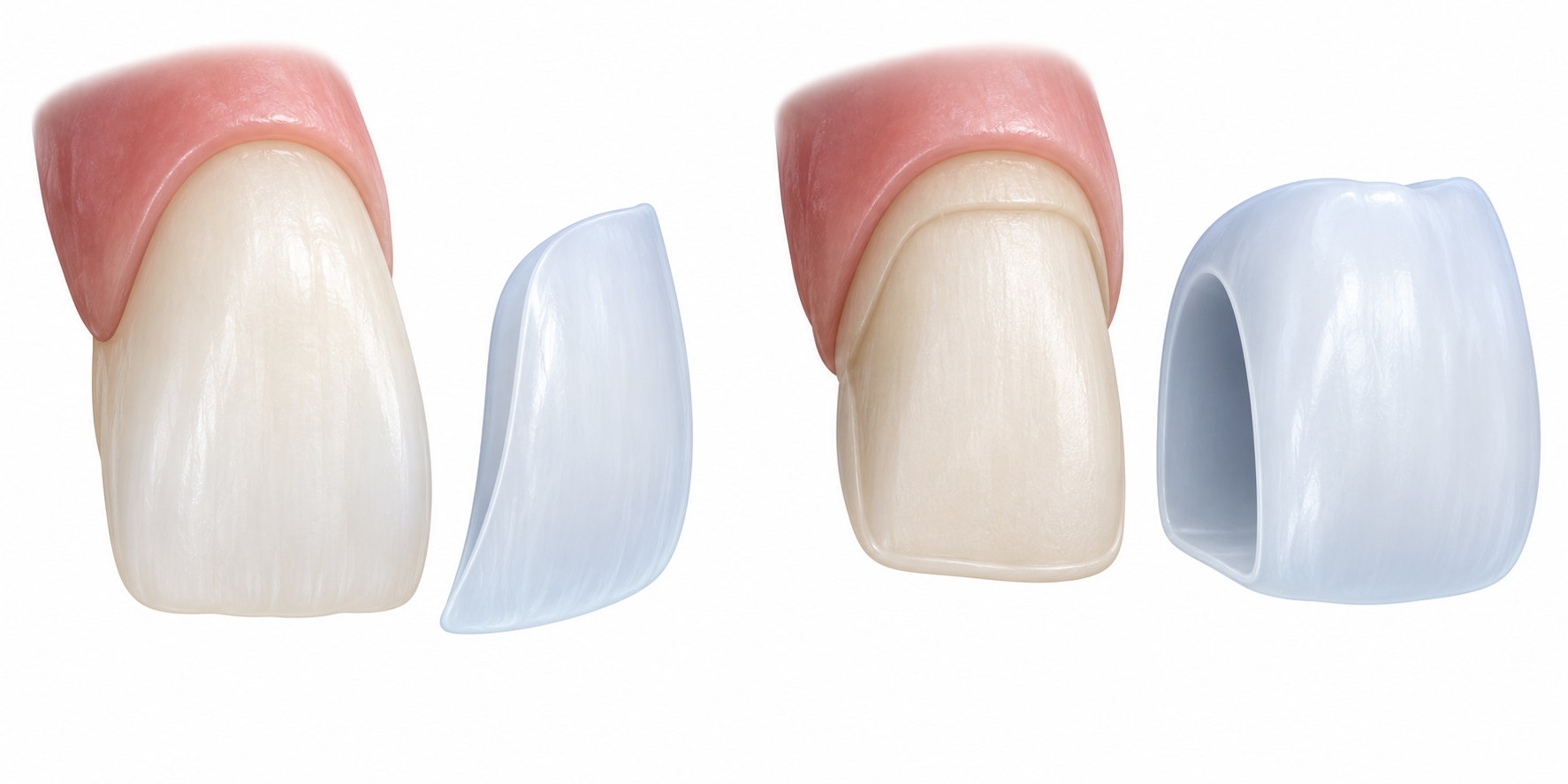
A veneer is a thin shell — usually porcelain — bonded to the front surface of a tooth to change its colour, shape or alignment. A crown is a cap that covers the entire tooth, restoring it after significant damage or after root canal treatment. Veneers are mostly about appearance on a fundamentally healthy tooth; crowns are about rebuilding and protecting a tooth that has lost a lot of its structure.
Everything else flows from that. Because a veneer only covers the front, we remove far less tooth to fit one. Because a crown wraps the whole tooth, it can hold together something that would otherwise crack — but it asks for more preparation in return. Neither is a compromise; they simply answer different problems.
Side-by-side comparison
Here is how the two stack up on the factors patients ask us about most. Treat the figures as a starting point for conversation, not a verdict — your own teeth always have the final say.
| Factor | Veneers | Crowns |
|---|---|---|
| What it covers | Front surface of the tooth only | The entire tooth, all the way round |
| Tooth preparation | Minimal – a thin layer of enamel | More extensive – the tooth is reshaped |
| Best suited to | Cosmetic concerns on healthy teeth | Damaged, heavily filled or root-treated teeth |
| Strength & protection | Improves looks, limited structural support | Holds a weakened tooth together |
| Typical materials | Porcelain, E-Max, composite | Zirconia, E-Max, porcelain-fused-to-metal |
| Indicative cost per tooth (UK) | £500 to £1,000 | £600 to £1,200 |
| Indicative cost per tooth (Antalya) | £180 to £320 | £160 to £300 |
| Reversibility | Largely irreversible once enamel is shaped | Irreversible |
The figures above are indicative ranges shared for information only and are not a quote or a price guarantee. Costs vary with the material, the number of teeth, the condition of each tooth and the laboratory work involved. We can only give you an exact cost after a clinical assessment, so please contact the clinic to arrange one.
When veneers tend to make sense
Veneers shine when the teeth underneath are basically sound and the issue is how they look. If your front teeth are stained in a way whitening will not lift, slightly chipped, a little gappy or mildly crooked, a set of porcelain veneers can transform the smile while keeping most of the natural tooth intact. That conservation is the whole appeal — we are dressing healthy teeth, not rebuilding broken ones.
We tend to lean towards veneers when a patient:
- Has healthy, well-supported teeth with mainly cosmetic concerns
- Wants to address colour, shape, small chips or minor spacing on the front teeth
- Is keen to preserve as much natural enamel as is reasonable
- Has a stable bite and does not clench or grind heavily
For patients who want the most enamel-sparing route of all, we sometimes discuss no-prep Lumineers, which are ultra-thin and can in some cases be fitted with little or no tooth reduction. They are not right for every case — they suit specific situations — but they are part of the same conservative family. Our work with laminate veneers in Antalya covers where these thinner options fit and where they do not.
When crowns tend to make sense
Crowns are the answer when there is not enough healthy tooth left to simply dress the front. After a large filling, a deep crack, a root canal or significant decay, a tooth can be structurally weak even if it looks fine from the front. A crown wraps the whole tooth and holds it together, which a veneer cannot do — bond a thin shell to a fragile tooth and you have a smarter-looking tooth that is still fragile.
We often recommend a crown when a patient:
- Has a tooth that is heavily filled, cracked or broken down
- Has recently had root canal treatment, which leaves a tooth more brittle
- Needs to restore a back tooth that takes heavy chewing forces
- Clenches or grinds, where extra protection matters
Material choice matters as much as the crown itself. For front teeth we usually favour materials that mimic natural translucency, while back teeth often call for something tougher. Our page comparing zirconia vs E-Max crowns explains how we match the material to the tooth’s job and position so the result looks right and lasts.
The factor that actually decides it: your tooth
Patients often arrive having already decided, and we understand why — the internet loves a clean comparison. But the choice rarely belongs to preference alone. Dr. Dt. Aykut Onol and our team base the recommendation on what we see and on the X-ray: how much sound enamel and dentine remain, whether the tooth has been root-treated, how your bite loads that tooth, and what you actually want to change. A veneer on a tooth that needs a crown is a short-lived fix; a crown on a healthy tooth removes more structure than the situation calls for. The right answer sits where your tooth’s condition meets your goal.
This is also why we are careful about absolute promises. Both veneers and crowns have an excellent track record, but outcomes still depend on your enamel, your gum health, your bite and your habits — particularly grinding, which is hard on any restoration. Results vary from person to person, which is exactly why a proper examination comes before any plan. It is also common to use both within one smile: veneers across the visible front teeth and a crown on a neighbouring tooth that has been compromised, blended so the join is invisible.
Cost: why Antalya changes the maths
In the UK, a single veneer commonly runs from around £500 to £1,000, and a crown from roughly £600 to £1,200, depending on the material and the laboratory. The same work in Antalya generally lands at a fraction of that, and the gap rarely reflects cut corners — it reflects lower clinic running costs, not lower-grade materials. At Morsia Dental we work with German and Swiss materials and the same internationally recognised systems you would expect at home.
That said, the price you compare matters. A genuine like-for-like comparison should include the preparation, any temporaries, the final restoration and your follow-up reviews — not just a headline figure per tooth. We set this out transparently, and our detailed page on dental crown cost explains what is and is not included so there are no surprises mid-treatment.
Looks: can you tell the difference?
A well-made veneer and a well-made crown can both look entirely natural — the skill is in the shade matching, the shaping and the way light passes through the material. Where they differ is the canvas. Veneers let us build a result on top of a tooth you already like the shape of, which can make the final look feel very “you”. Crowns rebuild the whole tooth, which gives more freedom to correct a badly shaped or discoloured tooth but asks for more removal to get there.
For a multi-tooth cosmetic case, consistency is everything. We plan the whole smile together — colour, length, the curve of the edges — rather than treating teeth in isolation, whether the case is all veneers, all crowns or a mix. A digital preview before any tooth is touched is part of how we keep the result predictable.
Longevity and maintenance
Both restorations are designed to last for many years when they are well made and well looked after. Veneers and crowns are not maintenance-free for life, though; they are hard-working components that may need refreshing over a long lifespan, much like a quality restoration anywhere in the mouth. Grinding, biting your nails, opening packets with your teeth — these shorten the life of either one.
The upkeep itself is refreshingly ordinary:
- Brush and floss as normal — veneers and crowns are cleaned just like natural teeth
- Protect them from grinding — a night guard if you clench, which we can advise on
- Avoid using teeth as tools — no bottle caps, no chewing pens or ice
- Keep your check-ups — we catch small issues at the edges before they grow
Looking after the gum and the tooth beneath the restoration is what protects your investment over time, whichever route you take.
So, which is right for you?
If you take one thing from this comparison, let it be this: the better question is not “veneers or crowns?” but “what does this tooth actually need, and what do I want to change?” Veneers are the conservative, appearance-led choice for healthy teeth with cosmetic concerns. Crowns are the rebuild-and-protect choice for teeth that have lost structure. Many smiles end up using both. The right call sits at the intersection of your tooth’s condition, your bite and your goals — and it is a call best made together, with the examination in front of us.
If you are weighing up your options, send us recent photos or your dental records and we will give you an honest assessment of what suits each tooth, with no pressure either way.
Frequently Asked Questions
Are veneers or crowns better for front teeth?
It depends on the tooth, not a rule. If a front tooth is healthy and the concern is colour, shape or a small chip, a veneer usually makes sense because it conserves more natural tooth. If that front tooth is heavily filled, cracked or has had root canal treatment, a crown is often the safer choice because it protects the whole tooth. We confirm which suits you after an examination.
Do veneers or crowns require more tooth removal?
Crowns require more. A veneer only covers the front of the tooth, so we remove a thin layer of enamel. A crown wraps the entire tooth, so the tooth is reshaped all the way round and more structure is removed. This is one reason we reserve crowns for teeth that genuinely need that level of restoration, and prefer veneers when the tooth is fundamentally healthy.
How much do veneers and crowns cost in Antalya compared with the UK?
Neither a veneer nor a crown has a fixed cost: the plan and its cost are set individually after a clinical assessment. What changes it is the number of teeth involved, the material chosen and the amount of laboratory work, as well as whether any preparatory treatment is needed beforehand. Because every mouth differs, we can outline what your own treatment would involve only once your teeth have been examined, so please contact the clinic.
Can I have veneers and crowns in the same smile?
Yes, and it is common. Many patients have veneers across the visible front teeth and a crown on a neighbouring tooth that has been compromised. The key is planning the whole smile together so colour, shape and edges blend and the join is invisible. We design the case as a whole rather than treating teeth one by one, which keeps the final look consistent.
How long do veneers and crowns last?
With good care and regular reviews, both are designed to last for many years. They are not maintenance-free for life, though; they are hard-working restorations that may need refreshing over a long lifespan. Daily brushing and flossing, protecting them from grinding and keeping your check-ups all extend their life. Outcomes vary from person to person, which is why aftercare matters as much as the original work.
İlgili İçerikler
References
The clinical information in this article was cross-checked against the peer-reviewed publications listed below.
- Alghauli M et al. 3D-printed versus conventionally milled zirconia for dental clinical applications: Trueness, precision, accuracy, biological and esthetic aspects. J Dent, 2024. PMID: 38471580
- Innes NP et al. Preformed crowns for decayed primary molar teeth. Cochrane Database Syst Rev, 2015. PMID: 26718872
- Derksen W et al. Group 2 ITI Consensus Report: Technological developments in implant prosthetics. Clin Oral Implants Res, 2023. PMID: 37750528
This content is for general information only and does not replace an in-person examination, diagnosis or treatment. Please consult a dentist about your own situation.