
You’ve seen the transformations online. Someone flies to Turkey with stained, chipped, or uneven teeth and comes back a week later with a straight, white smile. The results look almost too good. And the price? A fraction of what you’d pay at home.
So what’s the reality? Are veneers in Turkey worth it? What do they actually cost? And what separates a beautiful, long-lasting result from a regrettable one?
This guide covers everything — from real before-and-after cases to material choices, pricing, the clinical process, and how to avoid the mistakes that give “Turkey teeth” a bad name.
How Much Do Veneers Cost in Turkey? (2026 Prices)
Here’s what you’ll pay per tooth at a reputable Antalya clinic, compared to other countries. These prices include the consultation, preparation, and final bonding.
Your treatment plan and what it costs are set individually after a clinical assessment. What moves it is the number of teeth involved, the material chosen for your veneers and whether preparatory work is needed — the porcelain option here is produced with IPS E-max material from Ivoclar Vivadent.
At Morsia Dental, veneer pricing is per tooth and all-inclusive. The quote we give you before you fly is the price you pay. No lab fees added on arrival, no surprise charges for temporary veneers or adjustments.
Why the Price Difference?
Same reasons as implants — lower operating costs, favourable currency exchange, and higher patient volumes. The E-max block your veneer is milled from costs the same whether it’s processed in Antalya or London. The difference is in the overheads surrounding that work.
What you should never accept is an offer that leaves out the details. If a quote doesn’t say which material is used or which laboratory makes the restorations, you cannot judge what you are actually getting. Ask for the material name and the laboratory, in writing.
Before and After: Real Veneer Results
Photos tell the story better than words. Here are real cases from Morsia Dental — patients who came to Antalya for veneer treatment and left with transformed smiles.
Case 1: 10 E-max Veneers — Discolouration & Minor Crowding
Patient: Female, 34, UK. Teeth were healthy but had deep tetracycline staining that whitening couldn’t fix, plus mild crowding on the lower front teeth.
Treatment: 10 E-max porcelain veneers on the upper and lower front teeth. Shade BL2 — bright but natural, not the “bathroom tile” white you see on reality TV.
Result: Even alignment, staining completely masked. She cried when she saw the final result in the mirror. Her words: “They look like the teeth I always wished I had.”
Case 2: Full Smile Makeover — 20 Zirconia Veneers
Patient: Male, 48, Ireland. Years of grinding had worn his teeth down significantly. Multiple chips, uneven gum line, and old composite fillings that had yellowed.
Treatment: 20 zirconia veneers covering all visible teeth. We chose zirconia for its strength — important for a patient with a grinding habit. Custom night guard provided for long-term protection.
Result: Full restoration of tooth length and symmetry. Natural shade A1 — the right level of white for his skin tone and age. He looked ten years younger without looking “done.”
Case 3: Minimal Prep Veneers — Gaps & Irregular Sizing
Patient: Female, 27, Germany. Naturally small teeth with gaps (diastema) between several front teeth. Didn’t want braces, didn’t want her teeth heavily filed down.
Treatment: 8 minimal-prep porcelain veneers. Because the teeth were small and we were adding width to close gaps, preparation was very conservative — less than 0.3mm removed from most teeth.
Result: Gaps closed, proportions balanced, tooth structure preserved. The before-and-after photos made her dentist back in Munich ask for our contact details.
E-max vs Zirconia Veneers: Which Should You Choose?
This is the question we get asked most. Both are excellent materials, but they have different strengths.
Our recommendation at Morsia Dental: E-max for the upper front 6–8 teeth where aesthetics matter most. Zirconia for patients with a grinding habit, for back teeth, or for full-mouth cases where durability is the priority. Sometimes we combine both — E-max on the front, zirconia on the sides and back.
The right choice depends on your bite, your habits, and what you want the end result to look like. We’ll recommend the best option during your consultation — not default to whatever’s cheapest or most profitable for us.
The “Turkey Teeth” Problem — And How to Avoid It
Let’s address the elephant in the room. “Turkey teeth” has become slang for overly white, bulky, obviously fake-looking dental veneers. You’ve seen them. They glow in photos. They look like a row of Chiclets. And yes — some clinics in Turkey produce this result.
Here’s how it happens and how to make sure it doesn’t happen to you.
Problem 1: Over-Preparation
Some clinics file teeth down to stumps — far more than necessary. This happens when the dentist plans to use thick, one-shade-fits-all crowns rather than thin, custom veneers. Your natural tooth structure is destroyed in the process.
The fix: Ask your dentist how much tooth will be removed. For E-max veneers, 0.3–0.5mm is normal. If they’re removing more than 1mm from the front surface, ask why. Sometimes clinical reasons justify more preparation, but you deserve an explanation.
Problem 2: Wrong Shade Selection
Patients fly to Turkey and ask for “the whitest option.” The clinic complies. The result is teeth that look unnervingly bright against the patient’s skin tone, lips, and eyes. White doesn’t equal beautiful. Natural equals beautiful.
The fix: Trust your dentist’s shade recommendation. At Morsia, we do digital shade matching and show you a mockup before committing. If you insist on a shade we believe will look unnatural, we’ll tell you honestly — and explain why a slightly warmer tone will look better in real life and on camera.
Problem 3: Crowns Sold as Veneers
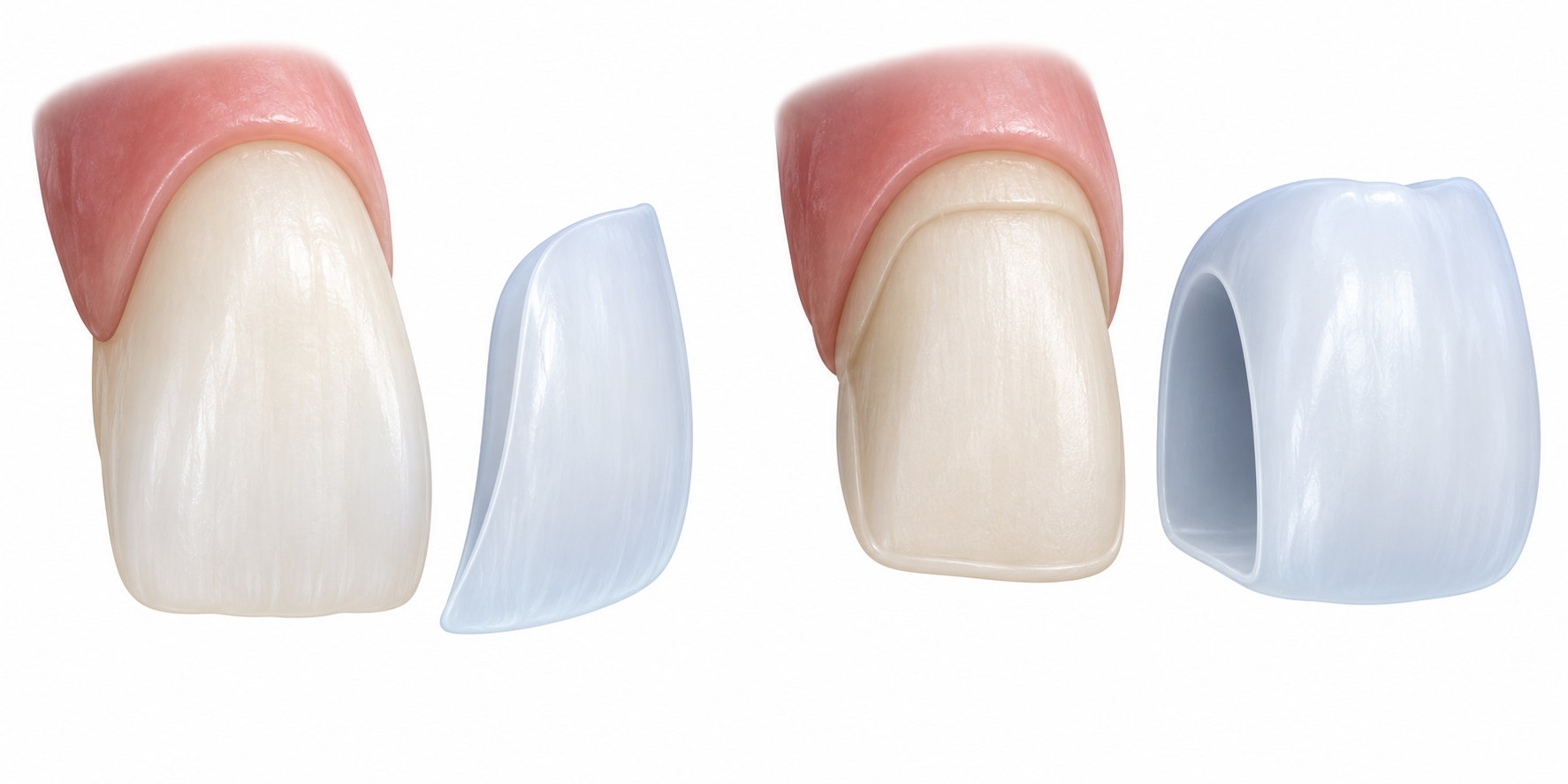
This is the one that makes dentists wince. A veneer covers the front surface of a tooth. A crown wraps around the entire tooth. Some clinics sell crowns as “veneers” because it sounds less invasive — but crowns require removing far more healthy tooth structure.
The fix: Confirm in writing whether you’re receiving veneers (bonded to the front surface) or full crowns (covering the entire tooth). Both have their place, but they’re different treatments with different preparation requirements. At Morsia, if you only need veneers, that’s what you get.
The Veneer Process: What Happens During Your Antalya Trip
A veneer treatment in Antalya takes 5–7 days from your first appointment to walking out with your final smile. Here’s the day-by-day breakdown.
Day 1: Consultation & Digital Planning
Full oral examination. Digital scans and photographs. We discuss your goals — what you want to change, what shade appeals to you, any concerns about the process. Using digital smile design software, we create a preview of your expected result. You see your new smile before we touch a single tooth.
Day 2: Tooth Preparation & Temporary Veneers
Your teeth are gently prepared — a thin layer of enamel is removed to create space for the veneers. It’s done under local anaesthesia. You won’t feel it. Precise digital impressions are sent to the lab. You leave with temporary veneers that protect your teeth and look presentable.
Days 3–5: Lab Work
This is where patience pays off. Your veneers are handcrafted in the dental lab over 2–3 days. Each veneer is individually layered, shaded, and characterised to match the plan. Rushing this stage is how clinics produce cookie-cutter results. We don’t rush it.
You’re free to explore Antalya during this time. Visit the Hagia Sophia. Take a Bosphorus cruise. Eat your weight in baklava. The temporary veneers are comfortable enough for normal activities.
Day 5–6: Try-In & Adjustments
The veneers arrive from the lab. We place them on your teeth for a try-in — checking the fit, shade, shape, and how they look when you smile. If anything needs tweaking, it goes back to the lab for adjustment. This step is non-negotiable. Some clinics skip it to save time. We never do.
Day 6–7: Final Bonding
Once you and your dentist are both happy, the veneers are permanently bonded using dental adhesive. Final polishing. Bite check. Photos. And then you smile at yourself in the mirror for what will probably feel like the first time.
Veneer Aftercare: Making Them Last
Porcelain veneers are durable, but they’re not indestructible. Here’s how to protect your investment:
- Don’t bite hard objects. No opening bottles with your teeth. No chewing ice or biting directly into very hard foods like toffee or whole nuts.
- Wear a night guard if you grind. Bruxism (teeth grinding) is the number one cause of veneer fracture. We provide a custom night guard for patients who need one.
- Maintain oral hygiene. Brush twice daily, floss daily. Veneers don’t get cavities, but the tooth underneath can — especially at the margins where veneer meets tooth.
- See your dentist every 6 months. Regular check-ups catch issues early. Your local dentist can monitor your veneers and clean around them.
- Avoid stain culprits in the first 48 hours. Coffee, red wine, and turmeric can stain the bonding agent before it fully sets. After 48 hours, porcelain veneers are highly stain-resistant.
With proper care, E-max veneers last 10–15 years. Zirconia can last 15–20 years or more. These aren’t temporary fixes — they’re long-term restorations.
Travel & Logistics: Planning Your Antalya Veneer Trip
Getting There
Antalya Airport (IST) connects to virtually everywhere. Direct flights from London: 3.5 hours. From Berlin: 2.5 hours. From Dubai: 4 hours. Budget carriers and Turkish Airlines both fly the route, so most European cities have several return options to compare when you plan your dates.
Visa
Most nationalities can obtain an e-Visa at evisa.gov.tr in under five minutes. UK and US citizens apply through that same official portal, where the current conditions are listed. Many EU citizens don’t need a visa for stays under 90 days.
Where to Stay
Morsia Dental helps arrange accommodation near the clinic. Most of our patients stay in Sisli, Taksim, or Besiktas — central Antalya neighbourhoods with easy access to restaurants, shops, public transport, and the Bosphorus waterfront. Quality 4-star hotels are easy to book in these areas, and we can suggest options that match your appointment dates.
Full Trip Budget
Because the appointments are grouped into a single trip, the 16 veneers, your stay and your travel all sit inside one schedule instead of being spread over months. The planning is straightforward.
Why Choose Morsia Dental for Veneers in Antalya
- International Health Tourism Authorization — certified by the Turkish Ministry of Health
- IPS E-max and premium zirconia only — no generic materials, every veneer traceable to its manufacturer
- Digital smile design — see your result before treatment begins
- In-house lab coordination — direct communication with the technician making your veneers, same-day adjustments when needed
- Conservative approach — minimum preparation philosophy. We preserve as much natural tooth structure as possible
- Try-in before bonding — you approve the final result before anything is permanently attached
- Free airport transfer and hotel arrangement assistance
- WhatsApp aftercare — ongoing follow-up and support after you return home
What Patients Say About Their Veneers
“I was terrified of getting the ‘Turkey teeth’ look. I told the team at Morsia I wanted natural — like my own teeth but better. They nailed it. People notice something’s different but can’t put their finger on it. That’s exactly what I wanted.”
— Rachel K., London, UK
“I had 20 zirconia veneers at Morsia. From first appointment to walking out with my final smile: 6 days. The temporary veneers were comfortable and the final ones look natural.”
, Michael O., Birmingham, UK
“My dentist in Berlin said I needed crowns on all my front teeth. Morsia said veneers would be enough and showed me why. Less drilling, lower cost, better result. That honesty earned my trust completely.”
— Lisa W., Berlin, Germany
You may also find it helpful to explore our guides on laminate veneer treatment details, smile gallery showcasing veneer results, and complete smile makeover packages.
Frequently Asked Questions About Veneers in Turkey
Do veneers ruin your natural teeth?
Veneers require removing a thin layer of enamel — typically 0.3–0.5mm. This is irreversible, meaning you’ll always need veneers or another restoration on those teeth. But “ruined” is not the right word. The preparation is minimal when done correctly, and the underlying tooth remains healthy and functional. The problems arise when clinics over-prepare teeth unnecessarily.
How long do veneers from Turkey last?
The same as veneers from anywhere else — it depends on the material and your care. E-max porcelain veneers last 10–15+ years. Zirconia lasts 15–20+ years. The lifespan has nothing to do with Turkey and everything to do with the material quality, the bond quality, and how well you look after them.
Can I choose the exact shade of my veneers?
Yes. We use a standard dental shade guide and digital colour matching. You’ll see samples and digital previews before committing. Our recommendation: go for a shade that’s 2–3 shades lighter than your current teeth. It’s enough to notice the improvement without screaming “I got veneers.”
What’s the difference between veneers and crowns?
A veneer covers the front surface of a tooth. A crown wraps around the entire tooth. Veneers are less invasive and preserve more natural tooth structure. Crowns are necessary when a tooth is heavily damaged or after root canal treatment. If your teeth are structurally sound and you want a cosmetic improvement, veneers are almost always the better choice.
Is the process painful?
The preparation is done under local anaesthesia — you won’t feel pain. Some sensitivity for a few days after preparation is normal, especially to hot and cold. Once the final veneers are bonded, sensitivity typically disappears within a week.
What if I don’t like the result?
This is why the try-in stage exists. At Morsia, we place the finished veneers temporarily so you can evaluate the look, feel, and fit before permanent bonding. If something isn’t right — shade, shape, alignment — we adjust. You don’t approve it, we don’t bond it. That simple.
Can I eat normally with veneers?
Yes, with some common-sense limits. Eat steak, bite into apples, enjoy your food. Just avoid using your front teeth to crack nuts, bite into bone, or open packaging. Treat them with the same care you’d give natural teeth and they’ll serve you well for many years.
Get Your Smile Transformation Started
Your new smile is a WhatsApp message away. Send us a few photos of your teeth and tell us what you’d like to change. Within 24 hours, you’ll have a personalised treatment plan with exact pricing and a digital preview of your potential result.
No commitment required. Just send your photos and let us show you what’s possible.
Need implants as well as veneers? Read our dental implants guide. Want to understand safety standards first? Check our honest guide to dental safety in Turkey.
References
The clinical information in this article was cross-checked against the peer-reviewed publications listed below.
- Alothman Y et al. The Success of Dental Veneers According To Preparation Design and Material Type. Open Access Maced J Med Sci, 2018. PMID: 30607201
- Alqutaibi AY et al. Clinical survival and complication rate of ceramic veneers bonded to different substrates: A systematic review and meta-analysis. J Prosthet Dent, 2025. PMID: 38604905
- Ahmed KE et al. Longevity of fiber-reinforced composite fixed partial dentures (FRC FPD)-Systematic review. J Dent, 2017. PMID: 28356189
This content is for general information only and does not replace an in-person examination, diagnosis or treatment. Please consult a dentist about your own situation.